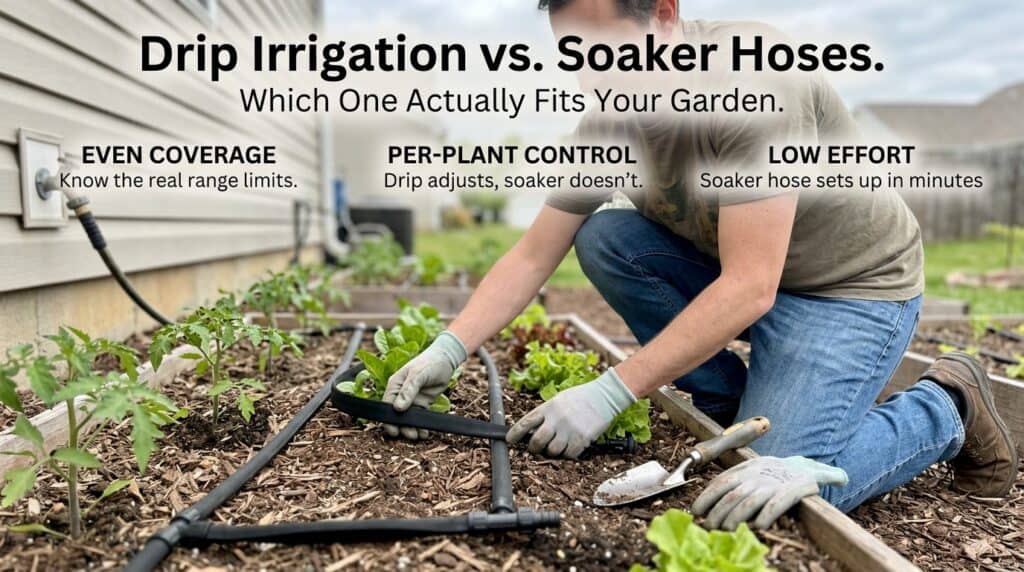
Both soaker hoses and drip irrigation water your plants at the base instead of overhead, cutting down on evaporation and the runoff that comes with sprinklers. Past that, they’re solving different problems. A soaker hose is one continuous porous tube – simple, cheap, and good for a short run. Drip irrigation is a network of solid tubing with discrete emitters – more setup, but precise and consistent even across a large or complicated layout. Which one actually fits your garden comes down to size, layout, and how much control you want over individual plants.
The Core Difference: How Each One Actually Delivers Water
A soaker hose is made from a porous material – the entire length of the hose is the “emitter.” Water seeps out along the whole tube at once, which is why it’s so simple to install: connect it to a spigot, lay it where you want water, done.
Drip irrigation uses solid, non-porous tubing with water released only at specific points – either built-in emitters spaced along the line, or separate drippers you attach where you want them. That point-by-point control is the entire value proposition of drip irrigation: you decide exactly where water goes and how much each spot gets, rather than watering the whole run evenly whether every foot of it has a plant or not.
The Soaker Hose “Cone Pattern” Problem
This is the part most soaker hose buyers don’t find out until after they’ve installed one. Because a soaker hose relies on water pressure pushing through a porous wall along its entire length, pressure drops as water travels further from the connection point. The result is a cone-shaped distribution pattern: the first 10-15 feet of hose puts out noticeably more water than the last 10-15 feet, sometimes 2-3 times as much.
This is exactly why soaker hose manufacturers and experienced gardeners recommend keeping individual runs to roughly 15-25 feet for genuinely even coverage, even though some soaker hoses are rated up to 100 feet or sold in 200-foot lengths. The longer rating describes what the hose can physically handle, not what waters evenly. If you need to cover more ground than that, running multiple shorter soaker hoses off a splitter, rather than one very long single run, keeps the watering more even across your whole garden.
“Drip Hose” vs. Soaker Hose – Don’t Confuse These at the Store
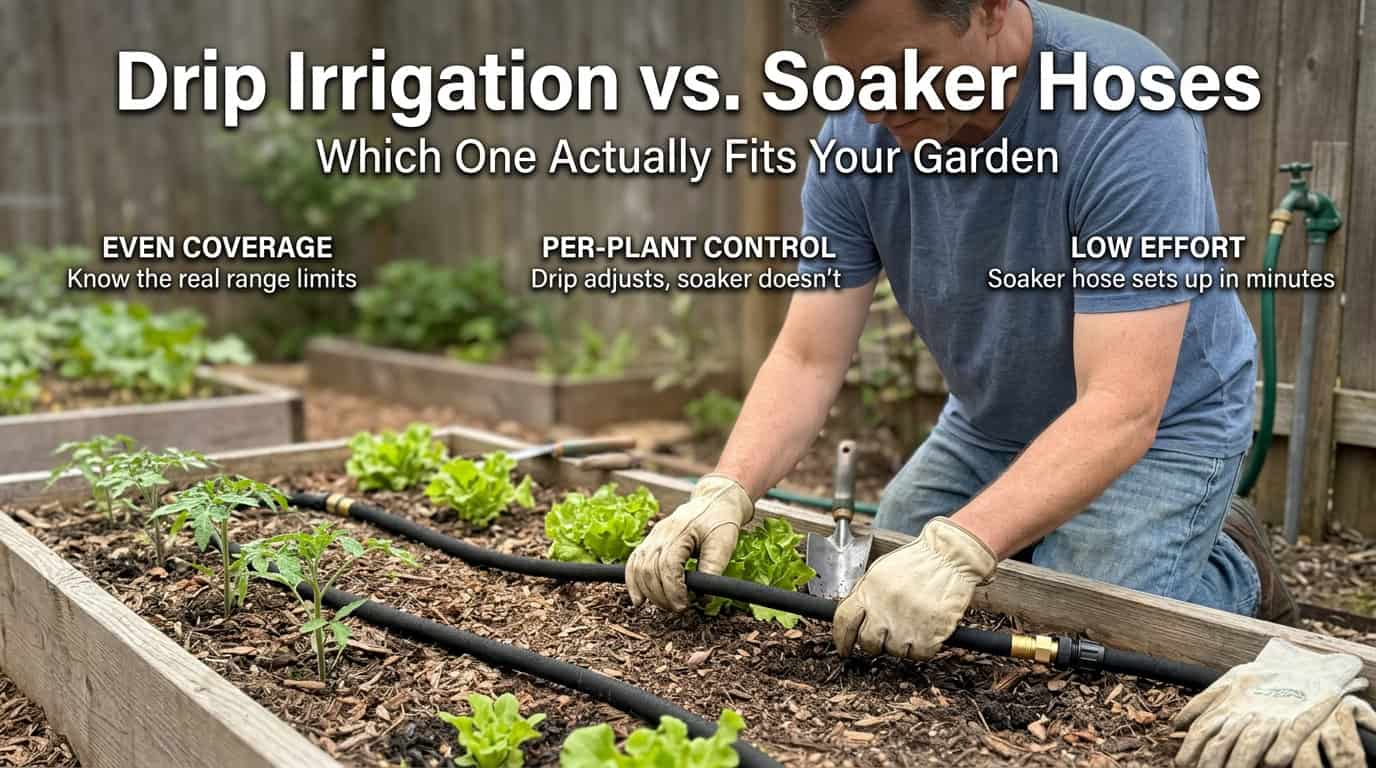
Adding to the confusion, some products marketed as “drip hose” are really just soaker hose with a different name, while others are genuine emitter tubing that functions like true drip irrigation. Genuine drip or emitter tubing has visible, evenly spaced holes or embedded emitters, and many are pressure-compensating, meaning they deliver the same amount of water at the 100-foot mark as they do at the connection point. Soaker hose, by contrast, has a uniformly porous wall with no distinct emitter points at all, which is exactly what causes the cone pattern above. If a product description doesn’t specify pressure-compensating emitters and instead talks about a porous or “weeping” material, treat it as a soaker hose for planning purposes, whatever it’s called on the package.
Quick Comparison
| Factor | Soaker Hose | Drip Irrigation |
|---|---|---|
| Typical starting cost | $15-40 | $40-200+ depending on system size |
| Even coverage per run | Best kept to 15-25 ft | Consistent across 100+ ft with pressure-compensating emitters |
| Install effort | Low – lay it out and connect | Moderate – plan emitter placement and runs |
| Customization | None – waters evenly along the whole hose | High – individual emitters per plant |
| Typical lifespan | A few seasons | 10-15 years with proper care |
| Repairability | Difficult – usually replace the section | Easy – splice or swap individual parts |
| Best suited for | Small-to-medium flat beds, rows of similar plants | Larger or sloped yards, mixed plantings, containers |
Soaker Hoses
1. Bluepro Flat Soaker Hose, 100 ft with Brass Splitter – Best Overall Soaker Hose
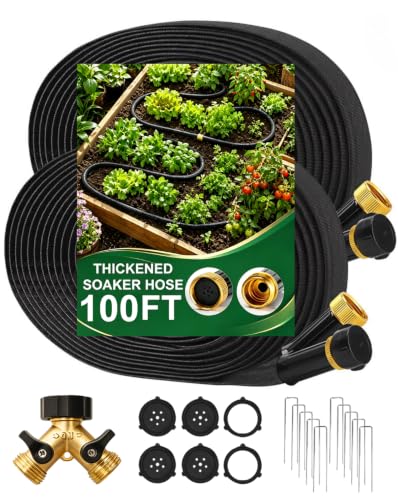
The included brass splitter is what makes this one worth calling out – instead of running the full 100 feet as one continuous soak zone (which would fall right into the cone-pattern problem above), you can split it into two more evenly-watered runs from a single spigot connection. The flat, reinforced 1mm construction resists kinking and coils flat for storage, and the aluminum seals at the connectors are a genuine upgrade over the plastic fittings on cheaper competitors.
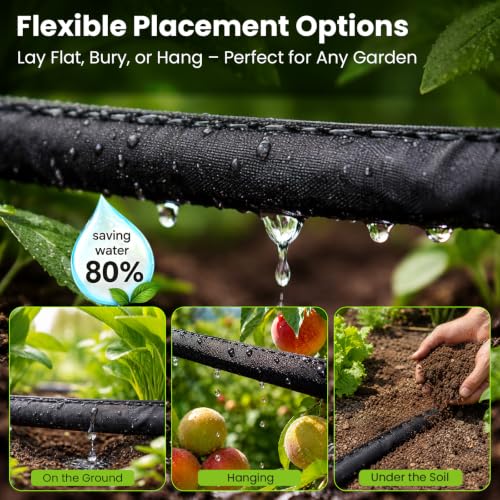
Not the right fit if: you only need to cover a small bed under 25 feet – the ZELTORK below is a better match for smaller spaces without paying for length you won’t use evenly.
Pros: Brass splitter helps manage the cone-pattern issue, reinforced 1mm hose resists bursting, aluminum seals reduce leaks at the connectors, flat design stores compactly.
Cons: Still needs to be split or run in shorter zones for genuinely even watering across the full length.
Buy it on Amazon today with FREE returns
2. Flat Soaker Hose 50FT – Best for Small or Medium Beds
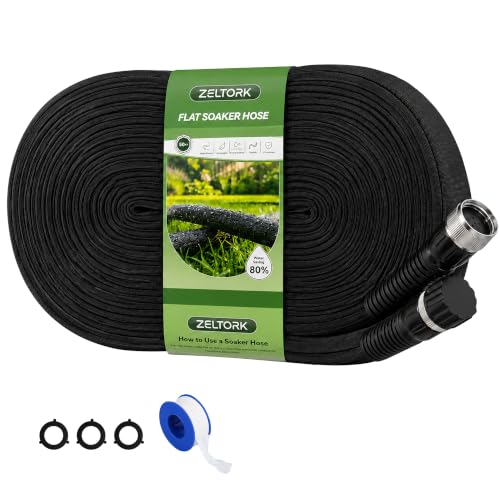
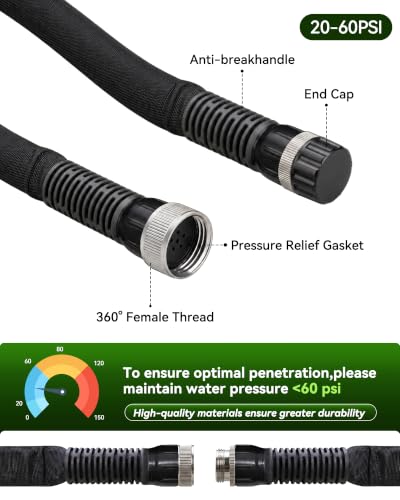
At 50 feet, this sits right at the upper edge of where a single soaker hose run still waters reasonably evenly, which makes it a sensible default length for a standard vegetable bed or a row of shrubs rather than something you need to split further. The dual-layer construction (a thickened PVC inner tube inside a fabric outer layer) is built to resist bursting and UV breakdown, and the anodized aluminum connectors hold up better under repeated connection and disconnection than plastic threads.
Not the right fit if: you’re covering a yard larger than a standard garden bed – the Bluepro or MIXC options handle bigger footprints with a splitter or heavier-duty construction.
Pros: 50 ft length keeps distribution reasonably even without needing to split it, dual-layer burst-resistant construction, durable anodized aluminum connectors, 360° rotating inlet for easy setup.
Cons: Not long enough on its own for larger yards without linking multiple hoses.
Buy it on Amazon today with FREE returns
3. MIXC 2026 Thickened Flat Soaker Hose, 200 ft with Copper Joint – Best for Large Yards / Best Durability
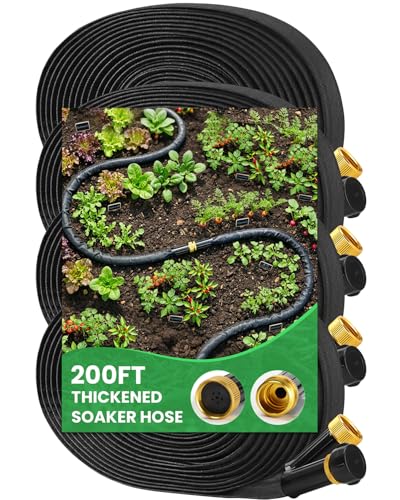
This is the heaviest-duty soaker hose on this list, with a 1mm wall (twice the thickness of standard soaker hose), solid copper joints instead of plastic, and a built-in pressure relief gasket specifically meant to help manage pressure buildup across a long run – a direct response to the cone-pattern problem this article covers above. At 200 feet, it’s meant to be split across multiple zones rather than run as a single line, and the hardware here is built to survive that kind of repeated setup across a full season.
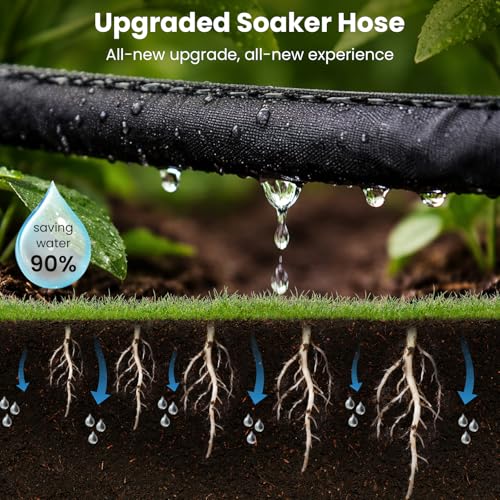
Not the right fit if: you have a small bed or patio garden – this is more hose and hardware than a small space needs, and the ZELTORK 50 ft option is a better value for that scale.
Pros: Thickest hose wall on this list, copper joints resist corrosion better than plastic, pressure relief gasket helps with long-run distribution, sunproof material resists UV breakdown.
Cons: Needs to be split into shorter zones for even coverage, like any long soaker hose. Higher price than the shorter options here.
Buy it on Amazon today with FREE returns
Drip Irrigation
4. GARDENA Starter Set Underground Drip Tube – Best Premium / Most Consistent Pressure
This is genuine pressure-compensating drip irrigation, not a soaker hose with a different label – GARDENA specifically states water pressure is the same at every point along the tube, which solves the cone-pattern problem entirely rather than just managing it. It’s designed to be buried underground along plant rows, so the tubing disappears from view entirely while still delivering water directly to the root zone, and the self-sealing drip heads include a root blocker to prevent roots from growing into and clogging the emitters over time – a common failure point on cheaper drip systems.
Not the right fit if: you want visible, easily adjustable emitters for a container garden or raised bed – this is built for underground row installation, not the flexible above-ground layout the HIRALIY kit below offers.
Pros: True pressure-compensating design with even output along the entire line, self-cleaning drippers with root-growth protection, buried installation keeps it out of sight, GARDENA’s 30+ year track record in this category.
Cons: Underground installation is more labor to set up than a surface-laid system. Higher upfront cost than a basic soaker hose.
Buy it on Amazon today with FREE returns
5. HIRALIY 50FT Drip Irrigation Kit – Best Budget / Beginner Drip Kit
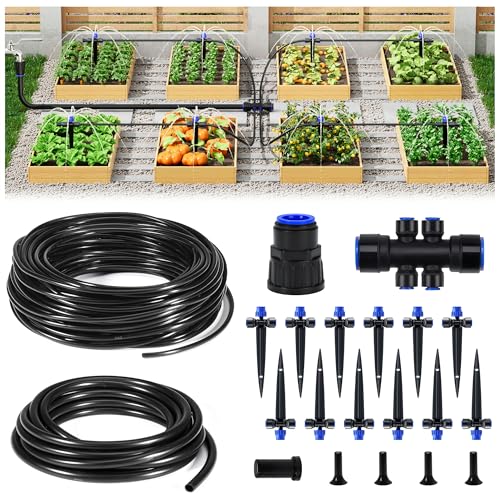
This is the most approachable entry point into true drip irrigation on this list. Each of the included emitters is individually adjustable between stop, micro-drip, and spray settings, which lets you give a thirsty tomato plant more water than a nearby succulent on the exact same line – the customization a soaker hose simply can’t offer. The brass splitter and quick-connect fittings make it realistic to set up in an afternoon without any plumbing experience, and it’s sized right for containers, a raised bed, or a small vegetable patch rather than a whole yard.
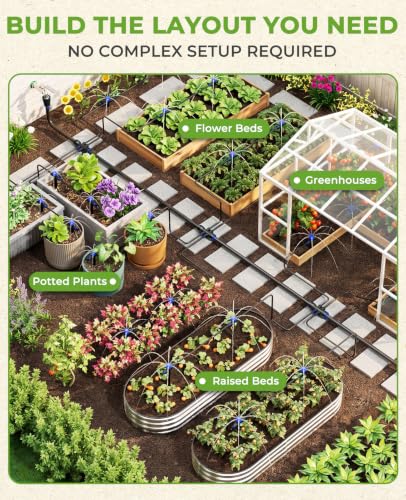
Not the right fit if: you’re watering a large yard or a long row of plants with similar needs – the GARDENA system above is built for that scale, and a basic soaker hose is simpler if every plant on the line wants the same amount of water anyway.
Pros: Individually adjustable emitters for real per-plant customization, brass splitter and quick-connect fittings simplify setup, budget-friendly entry point into drip irrigation, well suited to containers and raised beds.
Cons: 50 ft coverage is limited for larger spaces. Plastic components throughout are less durable long-term than the GARDENA system’s build quality.
Buy it on Amazon today with FREE returns
6. Rain Bird DRIPKITBAG Repair and Expansion Kit – Best for Expanding or Fixing an Existing System

This isn’t a starter system – it’s what you reach for once you already have drip irrigation and need to patch a break, replace a clogged emitter, or extend coverage to a new bed. The 102 professional-grade parts and 100 ft of 1/4″ tubing cover the most common repair and expansion scenarios, and the 40 included emitters are genuinely pressure-compensating and self-piercing, matching the quality level of a professionally installed system rather than generic hardware-store parts.
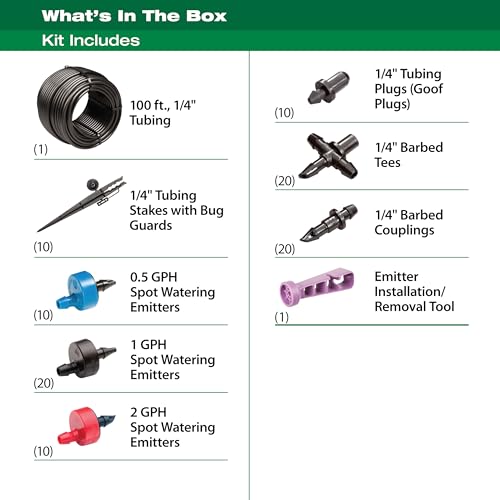
Not the right fit if: you’re setting up drip irrigation for the first time – this is a maintenance and expansion kit, not a complete starter system. Start with the GARDENA or HIRALIY kits above instead.
Pros: Professional-grade, pressure-compensating emitters, comprehensive part selection covers most common repairs, dedicated installation/removal tool for emitters, reusable across multiple seasons.
Cons: Not a standalone system – you need existing drip infrastructure or another kit to build a system around it.
Buy it on Amazon today with FREE returns
When a Soaker Hose Makes Sense
Small-to-medium flat beds, a row of plants with similar water needs, budget-conscious or seasonal use, and situations where you want something running in minutes rather than planned out in advance. If everything on the line wants roughly the same amount of water and the run stays under about 25 feet (or is split with a device like the Bluepro’s brass splitter), a soaker hose does the job with the least effort and lowest cost.
When Drip Irrigation Makes Sense
Larger or sloped yards, mixed plantings where different plants need different amounts of water, container gardens, and any setup where you want to add a timer for hands-off watering. The upfront cost and setup time buy you precision and consistency a soaker hose can’t match, plus a system that’s realistically built to last a decade or more instead of a few seasons.
Frequently Asked Questions
Can you bury a soaker hose the way you can bury drip tubing?
It’s not recommended. Soaker hoses rely on their porous surface being in contact with open air and soil to weep evenly, and burying them can cause mineral buildup and clogging in the pores over time. Drip tubing with proper emitters, like the GARDENA system above, is specifically designed for underground installation.
Do soaker hoses or drip systems work with a timer?
Both can be connected to a hose-end timer at the spigot. Drip systems get more value out of a timer since you can dial in precise watering duration per zone; a soaker hose timer mostly just automates on/off since the hose itself has no way to adjust flow per plant.
Which is better for raised beds?
Either works, but drip irrigation’s per-plant customization is a bigger advantage in a raised bed where you’re often growing several different plant types close together with different water needs. A soaker hose is simpler if the bed is planted with one crop type throughout.
Does drip irrigation need a pressure regulator?
Many systems do, especially if your home’s water pressure is on the higher end – too much pressure can blow out fittings or cause inconsistent emitter output. Check your specific kit’s recommended pressure range; some, like flat-style tubing systems, explicitly require a pressure reducer to work properly.
How long do soaker hoses actually last?
Typically a few seasons of regular use before the porous material degrades, clogs with mineral deposits, or develops uneven wear. This is meaningfully shorter than drip tubing’s typical 10-15 year lifespan, which is part of the cost trade-off between the two systems.
Bottom Line
For a small bed or a simple row of similar plants, a soaker hose gets water down with the least setup and lowest cost – just keep runs to around 25 feet, or use a splitter like the one included with the Bluepro hose, to avoid the cone-pattern unevenness. For anything larger, sloped, or planted with a mix of thirsty and drought-tolerant plants together, drip irrigation’s per-emitter control is worth the extra planning, and a pressure-compensating system like the GARDENA kit solves the distance problem that soaker hoses can’t.
If you’re setting up a new bed to water, our guide to pruning shears and loppers covers the tools you’ll need once things start growing in.